
Quadrant Exchange
Audit Clauses: Broad vs. Narrow
Introducing the Quadrant Exchange: Where we believe healthy dialogue on important issues requires thoughtful back-and-forth, that challenges assumptions, sharpens perspectives, and encourages deeper understanding. The lens through which we examine a topic matter because experience, expertise, and context all shape how risks, opportunities, and solutions are understood.
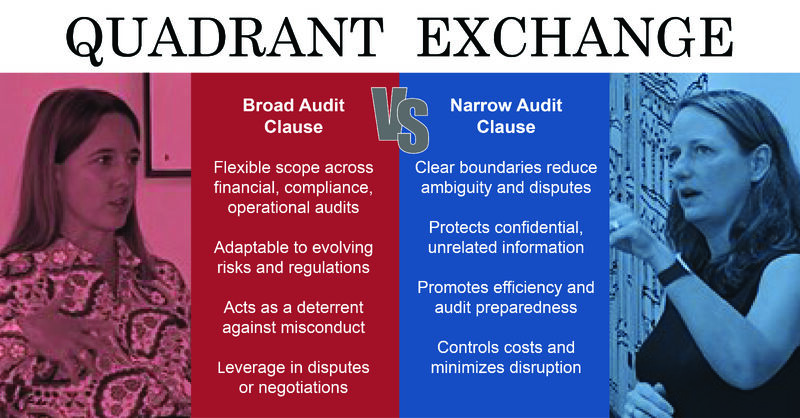
IN FAVOR OF: Broad Audit Clauses
Jennah Michalik, Senior Counsel
SUPPORTING ARGUMENT: A broad audit clause in a commercial contract is advantageous for a party seeking greater flexibility and leverage to best audit the commercial relationship now and in the future.
By keeping the audit rights general in nature, the auditing party retains the ability to scrutinize the counterparty’s financial records, performance, or compliance practices without being restricted by overly specific procedural or short look-back periods.
This flexibility allows the auditing party to adapt its approach based on evolving business needs, regulatory changes, or emerging concerns about counterparty’s mismanagement and/or misconduct. Moreover, a broad clause can act as a deterrent against non-compliance, as the counterparty may act more cautiously, knowing that their activities could be reviewed at any time with little warning. When negotiating the audit procedures, it also provides bargaining power, as it allows the auditing party to define the scope of the audit as broadly as necessary to meet its needs and requirements enabling it to demand transparency when disputes arise.
Thus, for a party in a position of power or oversight, maintaining generality in audit provisions can serve as a strategic tool to manage risk and ensure accountability of the counterparty.
POINTS OF DISCUSSION
- Flexibility in Scope: Allows the auditing party to review various aspects of the commercial relationship (financial, operational, compliance) without being limited to predefined categories.
- Broad Interpretation Power: Gives the auditing party greater control over the interpretation and enforcement of audit rights, which enables the auditing party to address evolving regulatory, business, or operational needs without requiring contract amendments.
- Deterrent Against Misconduct: Encourages the counterparty to maintain compliance and transparency, knowing they can be audited at any time.
- Audit Scope Leverage: Provides a tool for applying pressure or asserting rights in case of disputes or performance issues.
- Easier Enforcement: Broad clauses minimize the procedural hurdles that overly detailed audit terms create.
- Precedent for Long-Term Control: Sets the tone for audit oversight of the relationship, which can be advantageous for risk management of long-term partnerships.
IN FAVOR OF: Narrow Audit Clauses
Jessica Eterno, Senior Counsel
SUPPORTING ARGUMENT: A narrowly tailored audit clause in a commercial contract is advantageous for the party seeking to limit the parameters of audits performed during the term of the contractual relationship (typically the audited party).
By defining audit rights narrowly, the parties establish clearly defined parameters for the audit process and scope that help to eliminate any disputes at the point in time when an audit is requested. The narrow audit clause provides a clear understanding of: (1) the process to request, run and conclude an audit; (2) the types of data, records, and systems in scope for the audit; (3) responsibilities for costs associated with the audit; and (4) consequences for non-compliance with both the audit process or the activities being audited.
This approach protects confidentiality, promotes audit efficiency, and ensures data relevancy for both parties. The audited party retains control over access to its data and can focus its efforts on retrieving data directly tied to the audited service or product which minimizes operational disruptions and safeguards it from inadvertent disclosure of unrelated information. For the auditing party, this targeted approach ensures access to the precise records needed to assess compliance with usage rights, eliminating the need to sort through an indiscriminate volume of unrelated data.
The result is a more streamlined and purpose-driven audit process. A narrow audit clause safeguards confidentiality while upholding accountability and fostering a cooperative, cost-effective approach to compliance. Ultimately, this strengthens the commercial relationship through clarity, efficiency, and foreseeability.
POINTS OF DISCUSSION
- Clarity in Scope: Establishes clear boundaries around the audit process – ranging from notice requirements and audit frequency to identification of in-scope data and systems to consequences for non-compliance.
- Efficiency: Enables proactive organization of data, records and systems in preparation for an audit enabling quick and thorough responses to audit requests by the audited party and focused review of those responses for compliance by the auditing party.
- Mutual Understanding: Creates defined boundaries and clear expectations which helps to eliminate disputes and foster cooperative engagement by the parties in the audit process.
- Risk Mitigation: Restricts access to unrelated data and systems by the auditing party enhancing protection of unrelated confidential information belonging to the audited party and reducing risks of unintended information disclosure to the auditing party.
- Cost Efficiency: Controls audit-related expenses and reduces operational burdens on the audited party by narrowing depth and frequency of audits.
This Bulletin is provided for informational and educational purposes only. It does not constitute legal advice or establish an attorney-client relationship. This Bulletin may be considered attorney advertising in some states.
Quadrant Law Group, LLP © 2026. All rights reserved. 203 N. La Salle St. Suite 2100, Chicago, IL 60601